
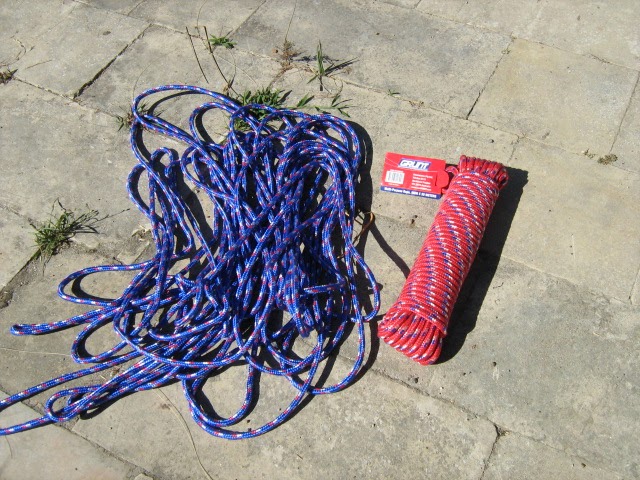
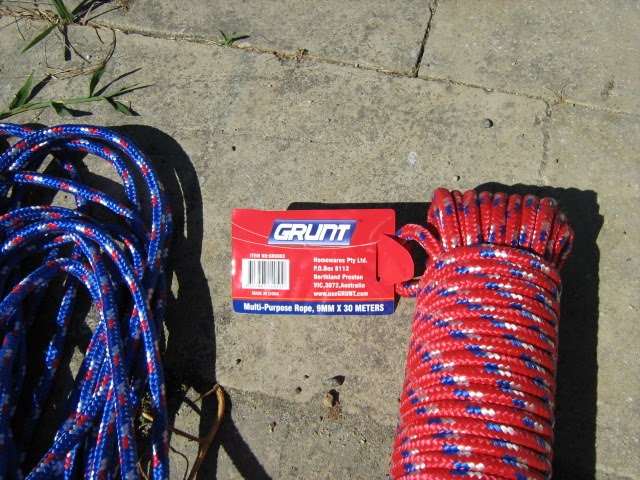
So when I was in the local Bunnings store ( its about the same as Lowes or any of the other big box nightmare hardware stores) and I saw a specials box with bundles of good looking 10mm ( 3/8in) braided rope in it, I looked. Rope, expecially that sort of size and looking like yachtbraid? Well, there is always a place on board for that. Gaff rigged boats use LOTS of rope, in fact I think anyone owning a big gaff ketch will just about need to buy a rope factory to go along with it.
Anyway, the price on these 30 metre ( 100ft) lengths was amazing, only NZ$8 90, ( about US$6 00 or so). At that it was never going to be the real deal, the good stuff, but how bad could it be? The colour for starters is not what you’d want to see on a traditional gaff rigged classic, but maybe it could be used as a dinghy painter, or to tie up to a jetty, or just as spare.
I bought two, brought them home, and peeled the outer cover back to see what was inside. Ahah! The core is not braided, its a bundle of split fibre, just an extruded strip of plastic about 50mm ( 2 inches) wide which has been rolled laterally into a round bundle, and the cover woven over it.
Thats not an automatic disqualification in itself, but it does mean that when the rope is under load there will be a strong tendency for the core to slide within the cover, bunching the cover and locally stressing the core.
it also means that its prudent to put a whipping on the ends of the rope to prevent pulling the core through the cover and away from the end.
I’d say that just melting it together as is the usual practice wont be enough, so put a whipping on it, and stitch the core to the cover with a needle and heavy thread. I dont think the usual 8 or 10 times through will work in this case, try 20 or so passes with the needle then a 50mm whipping over the top.
Next, I put the end of the rope in a flame, each different type of fibre has a distinctive way of burning , or a particular smell and this is not the high strength polyester or nylon rope that yacht braid is usually made from, it melted at a very low temperature, burned very easily rather than just melted and did not smell the same as my samples of either polyester or nylon braid.
It did though smell much the same as some cheap packaging twine that I think is polyproplene.
Here are some clips from a site which gives the properties of rope fibres.
Polyester looks and feels much like nylon, however, it has considerably less elongation and does not have increased elongation when wet. Polyester ropes are unaffected by water and are impervious to rot and mildew. They are more resistant to acids, but are sensitive to alkalis. Polyester is naturally quite UV resistant. Its melting point and performance at elevated temperatures are comparable to nylon.
Polypropylene is the least expensive of the common rope fibers. It is very light and therefore is often used where floatation is required. It is unaffected by water, and generally has good chemical stability. However, it is considerably weaker than nylon and polyester, and tends to deteriorate rapidly from UV radiation. Polypropylene ropes have a low melting point, and tend to exhibit high creep (gradual elongation under load).
You can see that Polyester is very good stuff for everything yachting except anchors where some stretch is a help in absorbing shock loadings, and polyproplene is not much good for anything except tieing up a horse. A small one at that.
It looks and feels nice, but be aware, dont get caught.
John
